.comment-link {margin-left:.6em;}

DIY Poetry Publishing Cooperative

March 14, 2009

An interview with Michael Schiavo by Lytton Smith...


...wherein the poets discuss independent bookstores, independent presses, self-publishing, the Espresso Book Machine, and more.

Part 1

Part 2

Order your copy of Schiavo's Mad Song, printed by the Espresso, here. Or stop by Northshire Books, if you're in the area.

Labels: , ,

May 01, 2008

Reb Livingtson at Very Like a Whale

I already put this in the aggregate feed in the sidebar (to which you've subscribed, no?), but it's so good, I think I'll also cajole you again from here.

Link.

Labels: ,

March 23, 2008

On small press poetry publishing

Johannes Göransson of Action Books answers some of his students' questions on his blog.

Labels: ,

February 28, 2008

What to Wear During an Orange Alert interviews Reb Livingston

I believe every "serious" poet should, in some way, assist and cultivate other poets. Poetry is a gift economy, nobody is making much/any money off her work. Some make livings teaching or editing at mid-sized to large publishing houses, sometimes poets get paid to speak, most make their living (or the bulk of it) doing something completely unrelated to poetry. Almost nobody is surviving on royalties and poetry book sales. So one must remember that every publication, every invitation to read, every review -- those are all gifts. Do you want to be the asshole who shows up to every Christmas empty-handed and leaves with a bag full of presents? I don't. I pride myself in being a completely different kind of asshole.You don't need much or any money to support other poets. It's easy to request free review copies and once you write a few reviews,review copies show up in your mailbox almost like magic. One doesn't need money to start a reading series in the community. One can spend very little money (or even do it for free) starting an online magazine. And with print-on-demand technology or other DIY means, one can publish a book for a few hundred dollars -- and in regard to POD, that includes an ISBN and distribution (i.e. you're available on Amazon, orderable in bookstores, etc.). One can discuss and promote other poets and books on her blog, speaking at conferences, during her own readings -- there's all kinds of ways to contribute back to the general poetry community. One's greatest gift is her time, energy and passion.

Read the rest.

Labels: ,

February 07, 2008

Just in case you don't already visit daily...

...stop by Ron Silliman's blog to peruse his answers to a Poetry Foundation questionnaire on the state of the art, which include several astute observations about industrial vs. small-scale, self- and DIY-publishing:

The consequence is that there are more active poets now than ever, but that the total addressable market for any given book of poems is likely to be much smaller. The trade presses have acknowledged this by largely abandoning the publication of poetry altogether, because for most the economics are not there to support the infrastructure required for a major trade publication.

&
And the role of the self-published book, the commercial object with perhaps the least prestige of all, has been important to poetry in the U.S. from Whitman to the web editions of today. But try to get Ingram to distribute your little chapbook. The book industry is exactly that, and its relationship to poetry is counter-intuitive at best. The days when major publishers brought out poetry as a “loss leader” (or because some poet might turn into a profitable novelist) are almost entirely behind us. The number of trade publishers who even touch poetry are so few, and their collective aesthetics so very narrow, that they have largely relegated themselves to irrelevance.


Lots more good stuff to ponder.

Part 1
Part 2

Labels:

January 27, 2008

A really great article on some DIYers in DC!

From the Washington City Paper:
Bots? Yes. God? Probably not. “I have a real love of post-New York School poetry,” says [Maureen] Thorson [of Big Game Books]. “I like things with a sense of humor, especially if it has robots in it. I’m a real sucker for robots and pseudo-post-Eastern European realism and stuff.” Don’t bother with John Ashbery impressions, though. “If I want to read John Ashbery, I can read John Ashbery,” she says. “He already exists. I also shy away from the religious stuff, unless it’s very odd.”

[...] “It’s just me running the press, so I try to let people know there’s not some objective panel of experts,” says Thorson. “Whether you get a book or not is whether or not I like it enough to make five little copies with my own little hands. If I take it, that’s a fun thing for you. If I don’t, I’m just one person, and I’m going to have my own weird quirks and tastes.”

In addition to Reen of Big Game, Michael Gushue of Vrzhu Press, Rod Smith of Edge Books, and Reb Livingston of No Tell Books also tell it like it is, invoke Papa Walt, pass the bullshit test, & explain the many fulfilling reasons why they DIY.

Good stuff! Go, y'all! Link.

Labels: , , , ,

July 05, 2007

The definitions of DIY

Our friend Scott Pierce of Effing Press is right--that the approach to DIY here is a little different or more open than it might be elsewhere. I think we've even talked about that before. Essentially, this blog is interested in poetry books produced by poets themselves (the micropresses featured here are usually one-person outfits, maybe a couple) outside the mainstream publishing houses. Because I think that's where the most exciting poetry is being published. That's lots of territory and healthy activity, and the focus definitely shifts around a bit. I realize the POD stuff isn't of interest to everybody here. That's cool.

Do see the comments to "Resistance Is Futile" below, for his and others' opinions.

My political/philosophical approach is that individual poets should become more involved in the publication of their own work, instead of sitting around waiting for somebody else, particularly the trade industry, to do it for them. I have personally found great satisfaction in making books (by whatever method) & I know it erases some of the usual frustrations and disappointments of being a poet. (Note: I am not disappointed to be a poet! You know what I mean, yes?) I think every poet should try self-publishing at least once or twice--or publish someone else's work--whether it's in a handmade chapbook or a POD edition. I think the experience clears up a lot of misunderstandings about what it means to have a book, and how these objects (on which way too much social/professional importance is placed, really) are made and how they get to readers. I *am* an optimist, and would like nothing better than for poets to focus more on the poems than the struggle to publish them. Doing It Yourself makes that possible.

Not everybody who wants to make poetry books has the same skill sets, and not everybody who wants to read poetry books has the same biases. There are many different ways to publish poetry on a small scale. Even though the POD/digital printing/distribution networks maybe be industries themselves, and as Scott points out do not give a hoot about poetry either, their lack of caring is not a limitation for poetry as it is in the trade publishing industry. (Bonus: POD networks also don't masquerade as cultural institutions.)

I don't see any need for one mode of publishing to be thought of as superior to the other--they're two entirely different things. (I'll be doing two editions of each Bloof book: one digitally printed and one handmade and maybe partially letterpress, for that reason.)

PS: John Tranter (of Jacket) has written to me backchannel about POD binding choices. He's given me permission to post his comments, and I'll do that sometime in the next couple of days.

Labels: , ,

July 01, 2007

Resistance is futile


Click to enlarge the images. These shots were taken in the same direct lighting, with the same camera, using the same focus and resolution settings. Can you distinguish a digitally printed page from an offset-printed page?


Prompted by a teeny link to the new Espresso Book Machine at Ron Silliman's blog the other day, Curtis Faville & I got to talking about whether or not print-on-demand (strategy) and digital printing (technology) are "cheapening the process" of publishing poetry.

I think Curtis makes many good points (as he often does), but I disagree with him (as I frequently do) that writers and publishers who opt to employ POD strategies and digital printing technologies are taking any less care with their work. In fact, I'd propose the exact opposite! Small, micro, and self-publishers who take the production process in hand exert complete control over the process and particularly in the case of self-publishers, are spending more time and effort on the presentation of their work than employees or authors of a large publishing house. They are taking full responsibility for the presentation of their work. Self publishers are extending the writing act to its furthest conclusion, all the way to the book in the reader's hands. (Control freaks rejoice!) Nothing at all impersonal about that--it's intimate even.

Anyway, both Curtis and I stray (really far) from the ostensible topic of the book machine, but since our remarks may be of interest to readers of this blog, I've cleaned up (oh the comment-stream-hasty-typos! the typos here are *much less hasty,* ahem) and expanded my remarks a bit and am reposting them here, in a slightly different form. (I do this not to joust with Curtis at all, but simply to take the opportunity to, well, pontificate further on a personal obsession.)

Argument: "Print-on-demand technology* will be a boon to those for whom the act of publication and reading is the merest convenience."

Reponse:
Many so-called mainstream publishers also use print-on-demand strategies and digital short-run technologies and they have been doing so for at least a decade now.

There are many economic and environmental incentives for publishers--no matter their size--to switch from traditional offset printing and traditional print-run guesstimates to produce their books. A few of these are: 1) Because it's no longer necessary to guess at how to supply an undetermined demand, print-on-demand publishing saves the (sad) waste of returns and remaindered copies having to be pulped (more about this later), 2) it saves lots of shipping and warehousing costs (both economic and environmental), and 3) it usually does not require large outlays of cash upfront for struggling small presses. None of these justifications for going POD in any way compromises the literary merit of the work inside the books.

Additionally, I believe there are several artistic advantages to adopting POD and digital printing methods, because the reduced expense and reduced waste results in a relative freedom from the fairly crippling economic concerns poetry publishers (and poets as a result) have come to face, and because it allows poets to produce their own books free from interference of any kind, should they choose to do so. POD allows publishers who focus on genres other than those that go blockbusters (such as poetry) to take more risks on work that might not otherwise make good business sense. They need not worry *primarily* about whether a book will sell. They can feel confident that making a great book available will not break the bank if it proves not to fly off the shelves in the requisite numbers. For these reasons, it's very good news for poets and their readers that the options are getting better all the time.

Argument (not Curtis's, by the way): Self publishing is crass, illegitimate, vain, or what have you.

Response:
I don't think this prejudice has quite the stranglehold it may once have had, and actually don't even know why I brought it up in the thread. Still, it bears repeating (perhaps ad nauseum) that I think the tendency to look down on self-published work is an outdated snobbery, and one that doesn't hold up when looking back at the history of poetry publishing in this country. I imagine most readers of [Ron's] blog (just for example) could name dozens of "famous" poets from their personal pantheons who self-published (or coterie published). That's how American avant-garde poets (and other writers, musicians, filmmakers, etc.) have long made space for themselves. The publishing "industry" will not, and frankly, that makes perfect sense, for some of the businesslike reasons already discussed.

One of the arguments I frequently hear from people objecting to self-publishing is, to paraphrase rather crudely, Editors know better than Writers. To which I always say, oh freaking spare me. This "gatekeeper theory" is generally espoused by those already within the gates, or those who possess an unshakable self-confidence in their own worthiness to reside within those gates at some future date. I applaud their confidence I guess, & being chosen by an editor is really nice--it feels good--but it doesn't mean all work that isn't chosen by an editor is automatically crap. Editors are wonderful, smart, dedicated people, by and large, who love the work they publish. But the reality is that to be an editor at a major publishing house in NY all one really needs is a BA, a willingness to work long hours for crappy wages, and the ability to develop a thick callus over one's artistic ideals. I say that from experience. I quickly learned at my first job something that for some reason isn't so obvious to most writers: Publishing is a Business. Every decision is based on the bottom line, not literary or artistic merit. That's not to say--of course--that some fine literature doesn't get published; economic and literary concerns do frequently overlap! But since that's most often not the case for poetry, according to the publishing industry itself, that's not the kind of gatekeeping poetry needs.

The Editors Know Better assumption also begs the question which editors? I believe editors and publishers who are poets themselves are the best editors and publishers for poetry. They must at least be avid readers of poetry--and how many avid readers of poetry do you know that are not also writing poetry? That might sound inbred, but if an editor or publisher is not immersed in the stuff herself, please explain to me how in the world she could know best. If poets make the best editors and publishers of poetry (they do), if publishing is an economically beleaguered business (it is), and poets are more likely to have MFAs than MBAs, do the math: less financial risk for poetry publishers is one of the best things about POD publishing.

Argument: Faster, cheaper production methods and self-publishing flood the field with too many throwaway books.

Response:
My feeling is that if POD strategies can relieve some of the purely economic considerations keeping good books from finding readers, I'd much rather sort through a thousand piles of "cheapened" "trivial" POD books to find those stunners than wait for the publishing industry to hand them to me prestamped with their approval. Because terrible poetry isn't scary. It's really simple to protect yourself against a bad book: you just close the cover.

Argument: "[R]ejecting traditional publication because of the the "bottom line" is NOT justifying poor quality and bad writing. Simply because you can literally produce a paperback book for $1.75 (at least for the moment) doesn't say anything whatsoever about its contents; and I would argue that that facility cheapens the process, both because of materials and because of a lack of responsibility."

Response:
I agree with the first half of this argument, particularly that the cost of production says nothing about content. I disagree that the facility (as in ease, not as in the physical printing facility, to clarify this out of context) has anything to do with cheapened materials (those are getting better all the time, more about which below), or that the relative ease of producing a book lessens anybody's responsibility. I've already sort of addressed that assumption above, saying that when poets take control of the production of their books they are exercising more responsibility in the presentation of their work, which is factually true.

The Xerox DocuTech 6180 printers and Xerox IGen 3 color process create really impressive pages, and I say that as somebody who is trained in letterpress printing. The text is clear and crisp, and though it is digital, at 300 dpi there's no discernable smushiness or pixelation. [Note, I followed the lead of another commenter and used "IBM Docutech" in the original thread, but wanted to be more specific here. IBM is the manufacturer and Xerox is the brand, 6180 is a model number and IGen3 is a proprietary name for this particular Xerox color press processing. These are the printers used by Lulu.com, Amazon's BookSurge, and other POD printers. They are high-tech, "profressional" machines, no doubt about it.]

Of course, it depends on how the digital files are prepared. Some POD or digitally-printed books don't look so hot because they are designed by folks who have not taken the time to learn about digital production. There's no "easy" way to lay out a digital manuscript and prepare it for printing. I mean, making a decent-looking book is not just a matter of dumping poems into a Microsoft Word document and clicking print. While some POD books may not be well designed, or may be inexpertly laid out, the same can be said of many books produced by other means. In other words, complaints about the design of a POD book ought to be registered with the designer of the ugly book, not blamed on the machines that designer used to make it. In other hands, the same machines are fully capable of producing books of what some people like to call "professional quality."

Generally speaking, POD publishers either hire designers or make the effort to learn the design fundamentals and software required to do it themselves. Self-publishers are successful designers insofar as they have taken the trouble to learn the same skills. Again, this amounts to more effort, more responsibility, and greater care.

POD companies are also introducing new paper stocks--heavier weights, recycled options, bright whites and creams, acid-free choices, etc. They only thing I'm personally still disappointed with is the choice of cover lamination--my service of choice (Lulu.com) does not offer matte covers. Other services (Cafe Press, for instance) does not seem to use lay-flat lamination and those covers can curl in humid conditions. I'm not aware of any POD service that offers uncoated or specialty cover stocks. But it's only a matter of time. The more publishers to use these services, the better they will get. (And that's where capitalism can actually help out. The POD services will supply if publishers demand.)

Argument: "You could even say with justice that ease of access encourages mediocrity."

Response:
This argument is related to the one above, and maybe I've already covered it? The idea is that if publishing is DIFFICULT the books will be BETTER. That's just funny. (Please do see Anne Boyer's Poetic Nonaction, on difficult ways to publish poetry!) Getting a first book published is harder than hell and still crappy ones come out all the time. How much harder does it need to be to keep all the Crappy Poetry from reaching us? (See above: don't be alarmed. Just read something else.)

Making new printing technologies accessible to the Rabble is Bad because some of the Rabble Suck? I can't really argue with that. I'm sure some of the rabble do suck. But many of them are probably also brilliant, and we get to find out.


Maybe I should point out that I have worked in publishing for nearly 13 years (OMG), in about every conceivable position from publicist to book designer to editor to publisher? So when I say the traditional print-run model is wasteful, I know what I'm talking about. Yeah publishers based their print runs on their best guesses about demand, but those guesstimates are notoriously off the mark (and FYI, almost never what the publisher says they are--they artificially inflate print-run numbers as a matter of course to "generate buzz"). To say overprinting "doesn't happen often" is inaccurate. Overprinting has been the default practice for decades. It's actually less expensive (bottom line) to print too many than to print too few, from the perspective of the big publishing houses. Printers, binders and trucking companies offer volume discounts. Going back for successive small printings, which would be less wasteful, is more expensive because the volume discounts don't apply, there are more shipping costs, and the printers and binders charge set-up fees for each print run.

Ever seen a dumpster behind a bookstore that sells mass-market paperbacks? They don't even bother to return and pulp those. They strip the covers and throw them in the landfill. By the 1000s...and 1000s. Trade paperbacks and hardcovers are returned (see, more shipping = more waste/environmental impact) then the publisher has to pay to have them pulped (more waste/environmental damage) and recycled (more waste/environmental damage). Those $5 hardcopies on the discount tables at the chain bookstores? Those are so-called remaindered copies, sold in prepicked lots (meaning the bookstore chooses by general subject category rather than choosing individual titles) in a last ditch effort to avoid having to pulp them. They’ve been shipped probably 4-5 times each: from the printer/binder to the publishing house (or its distributor’s warehouse), from the warehouse to the bookstores that placed orders, back from the stores to the warehouse, from the warehouse again in the prepicked lots after markdown. Those things weigh a ton. That’s lotsa Middle Eastern petroleum.

It just seems pointless and uninformed, frankly, to resist a decade-old technology that's already become the Way It Is, particularly when there are many benefits to leaving offset printing and overprinting behind. (Again, I don't just mean Curtis, but resistance at large.) Very soon there will be no discernable physical difference between a book produced digitally and one produced using offset printing plates. We're talking strictly about how the ink reaches the paper here, y'all. Offset printing is almost completely digitized these days anyway--the cylinders are created from digital files eliminating the need for film at all, and those files may or may not be stored on servers at the printing facilities for future reprints. That's just another way of saying POD, people! Offset printing continues to make good sense for high-volume projects where the expense of the set-up is outweighed or justified by the greater number of copies produced, but even in those cases, offset printers have another drawback that digital printers alleviate: once the cylinder plate is created, if there's a typo found or some other change that needs to be made, it's got to be scrapped and a new one must be made. (If an error is found in late stages in digital production, it's much easier/less expensive to fix.) Take a look at the photos at the top of this post. Click each of them to see a full-sized, high-resolution photo. Each page was photographed under the same conditions, in the same lighting, with the same camera using the same settings. The fonts are all classic-style serif book fonts. The paper is of four different types, and you may be able to discern some textural differences there. But check out the type (the center of each image will be most focused)--crisp, clear, no pixelation. Can you spot the digitally printed page?

Did anyone make these same kind of arguments about the advent of movable type? "Movable type and the printing press means instant books can be produced in 1000 hours vs. the usual 10000000 it takes Irish monks to hand-illuminate them. It's cheapening the process!" Grumble, grumble. I think any letterpress printer (bless their hearts and gorgeous work) will tell you that to print complete books by that method you must be kind of insane. They'd also tell you their goals and concerns have very little to do with the market. As it should be. Treating the book as a fetish object is natural for people who love books--why shouldn't they be as beautiful as possible?--but that kind of bibliophilia is AT ODDS with the sort of bibliomania that compels us also to find and read as many good poems as possible. (My solution for this particular schizoid rift is to release books in both the best-looking digitally printed version I am capable of producing as well as a limited-edition handmade version, so people have a choice. Other presses do this too--Tarpaulin Sky, for instance, did Jenny Boully's latest book that way.)

Offset printing was the "new" "cheapened" technology at its introduction too. The suggestion that just because a book is faster or cheaper or easier to print (and bind) its author or publisher took less care with it is pretty ridiculous. The text reads the same--which is the point, let's remember--whether it's offset in a print run of thousands, digitally printed on demand one at a time, or stapled fresh from Kinko's, and whether or not it has any branding stamped on the spine. (My most insistent point is always that the poem is primary but the rest is necessary.)

I don’t know how much this stuff matters to most writers, but the publishing industry has decided that Poetry is not worth bothering with from a business standpoint because they can’t sell enough copies to justify the expense and hassle of producing them. The way I see things, there are (at least) three ways to remedy that situation: 1) circumvent the publishing industry, 2) lower the cost of production, and 3) reduce the hassle of production. POD and services like Lulu.com (my current fave) allow individual poets and poetry publishers to do all three, and take some of the kinks out of the Problem of Distribution too. (A whole nother kettle, about which we've already talked lots before, yes?) (DIY publishing + a website or blog with a PayPal button is another strategy that also accomplishes all three.)

It seems to me poets would do well to embrace ANY technology or publishing method that might free them from the economic concerns that hobble the publication and distribution of their work, whether it’s handmade DIY chaps, blog-posted poems, internet journals, or digitally printed POD books.

* Note: On this blog I try to be careful about conflating POD with digital short-run printing, but the two get a bit mixed up fairly often, including these remarks. Briefly, print-on-demand (POD) is the publishing strategy of producing books only on an as-ordered basis, rather than in bulk. Digital printing is the technology whereby digital files (in the form of PDFs, Quark, InDesign, and other formats) are stored on computer servers accessible by digital printing machines like the Espresso Book Machine or the Xerox DocuTech printers like Lulu and other printing companies use. Though many print-on-demand books are produced using digital technologies, not all digitally printed books are POD and not all POD books are digitally printed. Our coeditor Sandra Simonds, for example, produces a handmade magazine that is essentially POD, in that she makes copies on request, not in a print run of a set bulk number. However, in general usage, "POD" usually refers to books printed one-at-a-time using machines like the IBM Docutech printers, after being digitally retrieved from a storage server. Whew.

Labels: ,

May 12, 2007

"Don't Call It a Vanity Press"

Time Magazine's got an article up on digital printing services like Blurb and Lulu. [via Jilly Dybka]
Self-publishing, the only real success story in an otherwise depressed industry, is booming, thanks to the Internet, digital cameras and more sophisticated digital printing. It's also gaining respect. No longer dismissed as vanity presses, DIY publishing is discovering a niche market of customers seeking high-quality books for limited distribution.

Read the rest.

Labels: ,

May 09, 2007

Dropped in the river like a sack of blind kittens, eh?

The most striking aspect of the showcase was the innumerable small and tiny presses that have risen to the challenge of publishing poetry in today’s marketplace, where commercial houses have dropped the genre like a sack full of blind kittens into a river. Presses like Factory School and Wave Books have recently emerged to join the ranks of Copper Canyon, Graywolf, and Hanging Loose as independent publishers exclusively devoted to putting out several volumes of new poetry a year. In addition, a hundred or so chapbook presses have sprung from the union of desktop publishing and DIY culture, producing often-beautiful pamphlet-sized books featuring the work of both emerging and established poets. Seeing so many books hand-stitched or letter-pressed, with silk-screened cover art, was a reminder of the effort and the pride that goes into this art[....]


From the May issue of the Brooklyn Rail, (though danged if I can tell who wrote it). Click the quotation to read the rest.

Labels:

April 28, 2007

Josh Corey on small press (and very small press) poetry . . .

For as long as I can remember I've been a haunter of bookstores and libraries. But I didn't begin to accumulate books in a serious way until I moved to the San Francisco Bay Area in 1999 to begin a Stegner Fellowship in Poetry at Stanford. It was there that I developed my interest in alternative American poetry, and started buying as much of it as I could afford. What do I mean by "alternative"? Contemporary poetry isn’t on many people's radar these days; even highly literate denizens of English departments don't always know much about what's going on in poetry. The poets who do break through to something like mainstream attention—John Ashbery, Mary Oliver, Louise Glück, and Billy Collins come to mind—actually represent fairly narrow swatches of what's been possible in American poetry for the past fifty years. These are the poets published by the big publishing houses, whose books actually stand a chance of being reviewed in the New York Times Book Review. But it's actually the small and really small presses in this country which have done the most to keep something like a living tradition of poetry alive. I should say rather "traditions," because the glory of American poetry is its multiplicity, the range of its techniques and styles and preoccupations. I have tried, in building up my collection, to accumulate as broad a swathe of these alternatives as one poor graduate student can.


Do read the rest.

Labels:

March 04, 2007

Why DIY? (Do what Red Morning Press says.)


The longer we run RMP, the more convinced I am that writers should take a serious look at self-publishing. We receive so many manuscripts that deserve to be published, but we simply can't publish them all. It's a shame that those authors will have to keep searching for a publisher or hoping to win a contest. One of the messages we wanted to communicate on the post card is that if anyone wants to self-publish or start their own press, we're here to help. If you want tips or advice on navigating the process, we're more than willing to share what we've learned.

Labels: ,

October 30, 2006

Why DIY? (Do what Charles Bernstein says.)

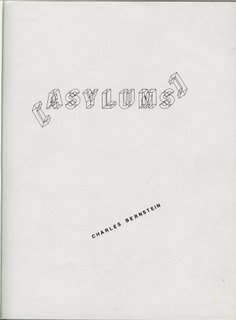
Twenty-five years after Charles Bernstein's first book Asylums was released in a xeroxed and side-stapled edition of "no more than 50 copies" by CB and Susan Bee, Craig Dworkin's Eclipse Archive has made the book available in a choice of facsimile or printable PDF formats here. Cool.
Announcing the release of these new electronic editions, CB has posted a short essay about the history of Asylum's Press, which went on to publish four other books, and more generally about DIY publishing:
I was, and am, committed to the concept of self-publishing; that writing poetry is part of a nexus of publishing poetry, reading poetry, reviewing poetry, writing poetics, teaching poetry. It was important to me not to just “privately circulate” my manuscript – which in a sense is what I was doing – but to publish it, to call it a finished work ready for the world, not waiting for someone else to legitimate. Also, publishing my own work in this way brought me directly in the economy of exchange that has been such a central experience of doing poetry [. . .]

&
My advice to young poets is always: start your own magazine or press, & publish your own work and those of your contemporaries whose poems seem most crucial for the art. And if possible, respond as much as possible, through poetics and reviews, to this work. Articulate its values, value its articulations.

Well, all right.

Read the rest.

Tags: Why DIY

Labels:

August 02, 2006

The new issue of How2 . . .

. . . features a small press publishing forum.

The questions:
* From forming editorial collectives to self-publishing, as poet-publishers and reader-writers, what models do we have to offer, imagine, devise (or how might existing publishing and distribution models potentially be mediated) as we endeavor to build innovative publishing models that defend and invent the conditions under and within which our writing exists, is produced and distributed?

* Small press publishing of innovative poetries provides a distinct subaltern model to existing modes of literary production and their means of distribution. How might an editorial poetics of publishing that includes (or exists exclusively as) gift economy alter, challenge and create economic and aesthetic resistance or subversion? Independent publishers, specifically those committed to avant-garde writing and its strategies, engage modes of representation that often are under specific pressures. What happens when presses commit to publishing chapbooks, either exclusively or in part? Where do chapbooks fall within this rubric of small press publishing, particularly as few bookstores or distributors are willing to carry them?

* Many independent publishers are committed to an editorial practice that challenges competition and the contest system now common to many university, non- and not-for-profit presses, especially in the United States. In what ways might contest-driven / competition models blunt critical inquiry or limit the possibilities of poetry itself? Communities tend to coalesce for a variety of reasons; how might we describe the communities that editors, publishers, distributors, poets and readers of independent presses are in the process of participating in &/or inventing?

Some outtakes:
"Working on Proliferation pushed me to articulate and commit to my opinions about writing in a way that being a workshop participant or literature student never had. It gave me a sense of confidence and focus. I finally started to understand that I was not asking permission to join the world of writers, I was a part of it. And it was up to me to decide what to do with that." --Mary Burger

"Many cultural conservatives--some who are otherwise liberal in their thinking--decry that there are "too many books," by which they mean, "too many to judge." From our point of view, the opportunities and realities of POD publishing suggest a decentering of critical authority, a comment on the instability of (or deliberate destabilizing of) canonicity in the age of the privatization of the public sphere. However, controlling the means of production is one thing; creating new channels of distribution, and making better use of old ones, is another." --Bill Marsh

"Why is it, I wondered, that The Book retains such primacy in avant garde poetic communities? These are thinkers who question everything about societal values, about the acts of reading and writing, about language itself. These are people who pioneered the DIY model of printing (I think of Diane DiPrima and Amiri Baraka's Floating Bear Press) and online publishing (UBU web). Nonetheless, in my experience, experimental poets enforce amongst themselves the status of The Book as much as any other group of writers." --Allison Cobb


Ack! Eek! & then Kristen Gallagher says "I've noticed there are fewer and fewer presses these days."

Luckily that's *not* true. & the lack of cash-upfront she laments? Why not POD?

Crossposted from the other blog.

Labels: ,

April 27, 2006

Illuminating the Why in DIY

Scott Pierce (of ever effervescent Effing) & Shann Palmer have been talking chapbooks vs. "real" books in the comment boxes dangling from Ron Silliman's blog, & as a result Scott has articulated in an open letter something of his love for making poetry.

See, I don't see the problem with handwork. Exercise and serious intent are for you, and you, and you. There is an issue of outsourcing here in our complainy poetry world too, see. It fits into the big-ass picture. I don't see how it is vain to go to the end of what you've started. What if, bear with with me, what if you are an artist. Say a mind and body not wholly satisfied or sated by merely writing, by merely seating the buttocks in the chair at the machine and its hypnotic glow. What if the artist writes and then the artist wants to do more with the words, wants to wrap them in silky cornleaf too, wants to make art of the vessel, maybe extend another of one's interest in the arena of graphics and textile manipulation to blend together in a thing called Book? What is a book.

A business so small and crucial you will be allowed to keep your day job. You will be allowed to think of others.

Is the choreographer that performs her dance vain for doing so? Is it a vanity dance?

Vanity art: a new movement in the age of inkjet?

I wonder if the inventor who tests her own creations is vain. Did not the Lumiere bros not make their own films with their own cameras? Wright bros? Did Ford drive a car?

Chefs cook vanity meals when they taste their own recipes?

To read Scott's letter is to vicariously settle your butt in that chair & feel your beer growing warm from the extended concentration of printing, trimming, binding & burnishing. Even simple bookmaking is a meditative experience, repetitive but not dull, exacting but exhilarating, that is difficult to convey. Hooray.

UPDATE: Kristy Bowen adds her thoughts about books vs. chapbooks, legitimacy & vanity here. An excerpt:
The vanity thing is complicated too. I think it's a loaded term with negative connotations. And I agree with Shann, we're all vain in the creative arts, and maybe there's nothing wrong with that. In regard to the other arts, the means of delivery are not quite so dependent on distribution and legitimacy bestowed by a third party. Visual art, while yes, getting into a posh gallery is one way to show your art, another is to rent out a space and show by yourself or with some fellow artists. End result is the same. Same with music. A hit record is nice, but no one calls it "vanity" if you put your own record out, or filmmakers vain when they shoot an indie without a big Hollywood budget. Literature, in general, seems so fucking squeamish about this. And maybe it's all the bad things that are passed off as poetry these days. Some of them ironically published by big presses (And how much of an advance did Billy Corgan get for his book with Faber and Faber? Does that make him a legitimate poet?) . We feel like we need that sort of legitimacy or we're no better than the woman writing and publishing poems to her cats.

Have I mentioned that I've got an essay about these very things in the latest issue of the Tiny? (I'll reprint it here, eventually, but not until their next issue comes out, & that's several months from now. Anyway, you should subscribe!)

PS: If you're interested in letterpress book arts, stay tuned for a week of daily notes as I take this class at the Center for Book Arts in May.

Labels: , ,

November 02, 2005

DIYers interviewed

An interview with Chris Rizzo of Anchorite Press, in which he discusses how and why he started the press, learning by doing, and other totally fascinating DIY publishing matters, is available here.

If you haven't yet started collecting Anchorite Press pubs, whatcha waiting for? Looks like there's a new one by Jess Mynes.

Jess has also recently published an interview with Michael Carr & Dorothea Lasky of Katalanche Press, here.

Good good stuff.

Labels:

July 30, 2005

Why DIY?

Here's an interesting piece on self-publishing by Brian Robert Hischier called "Anathema Revisited," in which he wonders aloud why what's good for independent filmmakers isn't also good for independent writers. (Good question, that!)

Labels:

July 23, 2005

Why DIY?

Robert Archambeau of Samizdat considers the DIY spirit of punk fanzines and how it applies to editing poetry journals (among other things) here.

Labels:

July 13, 2005

Why DIY?

Here are two views on the subject, for your reading pleasure.

Brenda Iijima of Portable Press at Yo-Yo Labs.

An interview with Buck Downs, of Buck Downs Books.

And here's a site, by an author who left a mainstream publisher behind to strike out on his own and do it himself:

Jim Munroe of No Media Kings.

Labels: