New from Kitchen Press: Out of Light by Joseph Massey
Yet another chapbook from Joe Massey, this time with our friends at Kitchen Press. Did that sound like disappointment? Because it wasn't. I just need coffee. But even uncaffeinated, I successfully PayPal-ed my way to a copy. Rock.
Out of Light by Joseph Massey
Published by Kitchen Press
35 pages
Saddle-stitched
$7.00
Cover design by Scott Pierce
Layout by Justin Marks
Fashion consultant: Meridith Rohana
CLICK HERE to order.
Out of Light by Joseph Massey
Published by Kitchen Press
35 pages
Saddle-stitched
$7.00
Cover design by Scott Pierce
Layout by Justin Marks
Fashion consultant: Meridith Rohana
CLICK HERE to order.
I read Out of Light straight through (rare for a book of poems) when it arrived late yesterday: and again (rarer still) this morning; focusing different facets of the prisms. The echo I felt was a memory of the pleasure of beginning Merrill Gilfillan's Magpie Rising--dispassionate language that shares a passionate view. That I was driven to learn more of the history, geography and politics of Humboldt County is a bonus. With this collection Massey has removed the last traces of clutter and lets emotion dance to nature. --Tom Raworth
Don’t call it a comeback! Because Massey’s been here for years! And he’s close to my age! He was writing to Ginsberg when I was copying Nirvana lyrics down. So the poems are already well-seasoned poetically and experientially. What makes these poems stay with the reader? They don’t quite let you relax. And they don’t simply exhibit skilled craft, tho they are skilled craft. If a poem is a little machine made out of words, like William Carlos Williams said, Massey’s poems are among the most reliable nerve stimulators. Starkly cut images sometimes as scary as the opening cuts in Texas Chainsaw Massacre. And it all has to work on the level of nerves, otherwise we’re just weaving pleasantries together. The emotion is facilitated not through sentiment but in the actual athletic feat of making a poem out of words. And making it so that it sticks to the brain. And there’s paradox, as in the dude’s professed predilection for an after-human world, or what could be misinterpreted as misanthropy, that is always undercut by what is really the raw stuff of human (mammalian) experience. Perception is always the most effective sharpening tool, and the poems in Out of Light expose the reader to true hugeness and intimacy. Poems condensed on the expressway to your skull. --Mike Hauser
For those familiar with Joe Massey’s work, Out of Light should continue to impress with a particular eye, and an equally particular ear, for the sensual or sensate. If it is true that the observer always alters the observed through the very act of measure, then Massey has certainly made an art of such alterations through the singular event of the poem. “No ideas / but in things,” Williams might say, but this no longer suffices. “A thrust of // things— / a world— / words—// crush / against / the margin of you” says Massey, and throughout this collection of exacting poems one is apt to experience a tension between how the poet’s world acts upon him, and how the poet acts upon his world, wherein the consequence of every act is measure itself. In Out of Light, there are no ideas but in such interactivity, an interactivity that bespeaks Joe Massey speaking. For those unfamiliar with his work, you will want to listen. And for those familiar with his work, you will want to listen—again. And again. --Christopher Rizzo
"Your poetry is like a bramble in my anus. And not in a good way." --Anonymous
"how the light/ makes do." All things contend with the weather, improvise a spar, feint around the canopy. And smudged. Smudged light and things are peripheral, overcast. "what/ sun/ a web/ snags." A next sense is sought and held to augment the washed-out other five -- something like a synaesthesia, underneath a bridge. --Buck Downs
In Out of Light, Joseph Massey pries open words with his 24 karat ear to expose a startling landscape where, “tree frogs // alliterate the dark,” where the moon is “mistaken for a cloud.” Massey directs light with a masterly precision in order to break open that gorgeous darkness that is our world— isolation, silence— and then a hummingbird shows up. And then the red bark of a tree, kelp, sea foam. And then the face, your face, “turned back by wind." And you see yourself in the landscape and it is no longer lonely, but as bright as the crystals inside a geode. --Sandra Simonds

Labels: Kitchen Press
posted by shanna at
6:31 AM
|
0 comments


 Carl Annarumo at Triptych Trencher is calling for submissions for a new series of chapbooks to be called "the greying ghost" as well as demo cassettes for their new-fangled-yet-old-school audio series. Details

 And speaking of
  The latest chapbooks from Katalanche Press--ambience is a novel with a logo by Tan Lin & Z Formation by Michael Slosek--are yours for the asking (plus $7.50 and $2, respectively) at the
  Eiríkur Örn Norðdahl's anthology of translations of experimental poetry into Icelandic, 131.839 SLÖG MEÐ BILUM (or, en Englais, 131.839 keystrokes with spaces), renders poems by Charles Bernstein, Jon Paul Fiorentino, Susana Gardner, Oscar Rossi, Kirby Olson, Leevi Lehto, Sharon Mesmer, Jan Hjort, Jesse Ball, Markku Paasonen, Jack Kerouac, Derek Beaulieu, Katie Degentesh, Paul Dutton, Nada Gordon, Paal Bjelke Andersen, Gherardo Bortolotti, Daniel Scott Tysdal, Iain Bamforth, Michael Lentz, Anne Waldman, Teemu Manninen, Mike Topp, Ida Börjel, Amiri Baraka, S. Baldrick, bpNichol, Charles Bukowski, Mairead Byrne, Mark Truscott, John Tranter, Sylvia Legris, Maya Angelou, Bruce Andrews, Haukur Már Helgason, Craig Dworkin, Shanna Compton, Lars Mikael Raattamaa, Vito Acconci, K. Silem Mohammad, Frank Bidart, Rita Dahl, damian lopes, Jelaluddin Rumi, Rachel Levitsky, Tom Leonard, Hans Magnus Enzensberger, Ian Hamilton Finlay, Ulf Karl Olov Nilsson, Caroline Bergvall, Christian Bök, e. e. cummings, Saul Williams, a. rawlings, Stephen Cain, Jeff Derksen, Linh Dinh, Nico Vassilakis, Martin Glaz Serup, Malte Persson, & Anna Hallberg with all kinds of funny-looking diacritical marks to amaze & befuddle nonspeakers. But don't let your haughty American monolinguism stop you! At least recommend it to your Icelandic friends. The book is available from ntamo's
  Switchback Books is proud to announce the release of Our Classical Heritage: A Homing Device by Caroline Noble Whitbeck. This debut collection of poems is the winner of the 2006 Gatewood Prize selected by judge Arielle Greenberg: "Our Classical Heritage is a pleasurable and witty work, pinned sharply but delicately to reality through images of cultural detritus and evocations of American childhood...[.]" Available
  Blood Pudding Press is pleased to announce that [GROWLING SOFTLY] is now available. [GROWLING SOFTLY] is a hand-designed, ribbon-bound poetry magazine, featuring the work of the following highly delectable muckrakers: Melissa Culbertson, Kyle Simonsen, Christine Hamm, Luc Simonic, Misti Rainwater-Lites, Rachel Lisi, Victor D. Infante, Sara Mumolo, Kristy Bowen, Melissa Crowe, Kenneth Pobo, Michalle Gould, Juliet Cook, Nikol Raquel Polidoro, Stephen Morse, John Rocco, Pablo Joaquin Lopez, Mary Alexandra Agner, Todd Heldt, T.A. Noonan, Jill Alexander Essbaum, Matina Stamatakis, Derek Motion, Peg Duthie, Shelley Nation, Elisa Gabbert & Amber Nelson. Get it from the Blood Pudding Etsy shop
  Anchiote Press has released several new chapbooks since we last checked in, and as usual they're offering twofer specials. Objective Practice by Mia You + Anchiote Seeds 3 = $12. Or Nicholas Manning's Novaless: I-XXVI + Anchiote Seeds 2 = 12. That's solid math, either way. Warm up your PayPal finger & visit
  Now available from Tarpaulin Sky Press:
  Like bugs? Check out the "insecta" issue of

 Lastly, here's a new distribution option for DIYers to check out. Katie Haegel will consider submission of zines & chapbooks of poetry and/or fiction over at
  Michelle Detorie of WOMB & Hex Presse has been busy making/planning handmade sets of cleromancy dice, poetry puzzles in specimen bottles, & a fresh new blogroll of more than 300 women poets. Stop by the
  E. M. Bertram of Shadowbox Press believes all good things come in threes. So for a limited time, you can get 3 books for 3 bucks off. The set includes
  Jen Tynes of Horseless Press has also been busy. Two new chapbooks are now available:
  INCH #4 IS OUT NOW! The smallest magazine around is back with microfiction from Michael McFee & Cynthia Reeves, & poetry from Jeffery Beam, Sebastian Matthews, & Mischa Willett. Order single issues (only a buck!)
  Tiny books. Big hearts. Eileen Tabios of Meritage Press has been up to some poetical philanthropy.
  House Press has many shiny new items avaiable, including
  Josh Hanson's got a newish press, kids. It's called
  Justin Marks'
  Carrie Hunter's
 Three new books from Mark Young's Otoliths Press are now available: Nick Piombino's by now legendary "visual collage novel"
 & forthcoming from Kitchen Press, look out for Run Down the Emphasis by Erin Elizabeth Burke, Why I Am White by Mathias Svalina, Tentative List by Thomas David Lisk, & Out of Light by Joe Massey.
 Elisa Gabbert's Thanks for Sending the Engine is now available from
  The title of Matt Rasmussen’s collection, Fingergun, speaks volumes. His taut verses are nothing if not action-packed, in the joyful manner of a child’s makebelieve--as long as one keeps in mind the troubling implications of the gun he mimics. In the book’s first poem alone, things unzip, jab, glug, stir, fall off, are pinned or nailed to other things, bolt, spiral down, sprint... (“This Place”). Rasmussen's language is constantly doing something, something virtually violent. Rasmussen repeatedly compares the poems themselves, or perhaps language in its violent performances (blame, accusation...), to the title’s index-finger-firearm: “The warm smoking muzzle of the line” (“The Field at the End of a Poem”). Rasmussen evokes in gory detail the effects of a handgun on his brother in “Dream after Suicide”--only to undo that suicide in the following poem, “Reverse Suicide.” Language, certainly, has no sticks and stones, but can it hurt? Rasmussen offers a compelling and sustained (the emblem of the gun binds the collection into a cohesive whole) reflection on the possibilities of linguistic virtuality (perhaps including real and lasting harm):
 Even more than Matt Rasmussen, Chris Tonelli favors (very) short forms in his Wide Tree: both writers were Bill Knott’s students at Emerson College, and Tonelli dedicates a brilliant homage to Knott, “Becos.” Tonelli seems to practice something like what Knott calls the “anti-poem”: Tonelli’s scatalogical, off-kilter humor (caveat lector) thumbs its nose at effusive pathos, gnomic gravity and L=A=N=G=U=A=G=E-poet verbiage alike:
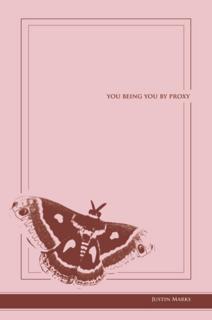
 The title of Justin Marks's own collection, You Being You by Proxy, which is also that of the opening poem, announces the poet’s preoccupation with the problem of divided subjectivity that has occupied so many 20th-century thinkers. This initial poem in fact paradoxically apostrophes a preconscious infant, describing to it the gradual formation of its self--through others:
 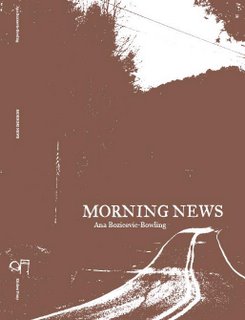 Perhaps the most subtle of the Kitchen Press poets, Croatian-born Ana Bozicevic-Bowling rarely engages in aggressive verbal pyrotechnics in her chapbook Morning News: her virtuosity is generally of a quieter, more minimal kind, sometimes reminiscent of William Carlos Williams’ understated lyrics of the quotidian, as in her brief vignette of her father: “Father / is out in the yard. He shaves / at the bucket [...]” (“Of Water”). To give texture to her language, Bozicevic-Bowling relies not on shock, but on unobtrusive displacements that surprise only after a moment’s reflection, like those paradoxically “warm drifters” of the book’s opening poem (“Prologue”). It is the reader’s growing familiarity with these poems that causes them, like the cafeteria of the same “Prologue,” to “overgrow with meaning.” Those occasional unexpected verbal explosions or troubling minor chords--the “swindled” eye of a child, the “stolen bonbon” of the sun--stand out all the more strikingly for their hushed surroundings (“For Voice and Violin”). The same reserve shows in Bozicevic-Bowling’s readings, which the reader may enjoy on the CD that accompanies Morning News (with music by Denim on Denim). These poems speak the language of deceptive familiarity, the same kind that the poet finds in the “things” she invokes in her final poem, and in the memory of those things:
  From Kathleen Rooney of
  From Sarah Nicholls at the Center for Book Arts: