4 Chaps from Kitchen Press: Review by Alexander Dickow
Four brief chapbooks (none exceeds thirty pages) display the heroic blender of Justin Marks's Kitchen Press, created in 2005, which this happy reader discovered through Boog City’s David Kirschenbaum. The books vary widely in all but appearance (monochrome covers over stapled binding) and readability. None of them abandon outright the fiction of the speaking voice, the elaboration of a singular poetic idiom or persona: in this respect, they may disappoint (at least at first glance) those who prefer the radical / insignificant / experimental / mainstream (depending on one’s point of view) poetries of L=A=N=G=U=A=G=E and its epigones. But neither do these poets abandon craft and invention, to which I stubbornly cling in my quest for readerly (and writerly) gratification. Kitchen Press books do not deserve the name of ephemera: unlike so many quickly forgotten chapbooks, these have already become fond and tattered inhabitants of my library.
 The title of Matt Rasmussen’s collection, Fingergun, speaks volumes. His taut verses are nothing if not action-packed, in the joyful manner of a child’s makebelieve--as long as one keeps in mind the troubling implications of the gun he mimics. In the book’s first poem alone, things unzip, jab, glug, stir, fall off, are pinned or nailed to other things, bolt, spiral down, sprint... (“This Place”). Rasmussen's language is constantly doing something, something virtually violent. Rasmussen repeatedly compares the poems themselves, or perhaps language in its violent performances (blame, accusation...), to the title’s index-finger-firearm: “The warm smoking muzzle of the line” (“The Field at the End of a Poem”). Rasmussen evokes in gory detail the effects of a handgun on his brother in “Dream after Suicide”--only to undo that suicide in the following poem, “Reverse Suicide.” Language, certainly, has no sticks and stones, but can it hurt? Rasmussen offers a compelling and sustained (the emblem of the gun binds the collection into a cohesive whole) reflection on the possibilities of linguistic virtuality (perhaps including real and lasting harm):
As the mention of “what happens” (and what doesn’t) suggests, Rasmussen constantly explores processes, focused transformations, evolutions--not excluding those of narrative. We witness the miraculous growth of a tube of lipstick into a “garden of mouths” (“Overnight”), the voyage of a bullet through the air (“Bullet”), the recurring motif of the tree’s branching growth (“Suddenly, the Poem Is,” “Overnight”). And like the growth of a tree, the ramifications of Rasmussen’s interlocking metaphors multiply with each new reading.
 Even more than Matt Rasmussen, Chris Tonelli favors (very) short forms in his Wide Tree: both writers were Bill Knott’s students at Emerson College, and Tonelli dedicates a brilliant homage to Knott, “Becos.” Tonelli seems to practice something like what Knott calls the “anti-poem”: Tonelli’s scatalogical, off-kilter humor (caveat lector) thumbs its nose at effusive pathos, gnomic gravity and L=A=N=G=U=A=G=E-poet verbiage alike:
Such poems do not fear, and do not fail, to entertain. They do not seek density nor complexity, torsions of syntax, idiosyncratic forms of expression: they seek the verbal bang! of laughter, surprise, amusement, perplexity. Tonelli seems unconcerned with making poems that last, rather taking joy in the totally ephemeral, immediate effect of these tiny punchlines. Paradoxically, the childlike vitality of these short poems makes them far more memorable and durable than the great majority of avant garde or post-avant lyrics. And Tonelli occasionally reveals his versatility by surprising the reader once again with lines of striking lyrical force. For instance, he concludes one humorous piece involving a toilet’s automatic-flush function (evoked in a parodically “biblical” style), thus: “Go, // tumble like a manuscript over the lawn” (“At a Theater Urinal”). And Tonelli’s tiny elegy for George Mazzoni is beautiful and moving enough, in my opinion, to be left unquoted here: Find it, and read it.
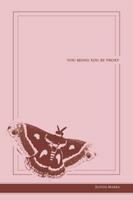 The title of Justin Marks's own collection, You Being You by Proxy, which is also that of the opening poem, announces the poet’s preoccupation with the problem of divided subjectivity that has occupied so many 20th-century thinkers. This initial poem in fact paradoxically apostrophes a preconscious infant, describing to it the gradual formation of its self--through others:
Marks consistently deals with preconscious or semiconscious states, as those ordinarily inaccessible to language. He does not describe them so much as he rhythmically echoes their internal movement. Verses describing the distracted reading of a book emulate the tone of rambling, distracted conversation:
These poems are meditations; they concern themselves with thinking (and not thinking). Yet they are not self-conscious, solemn and heavy-handed like so many tedious mainstream lyrics, but almost casual, playful, yielding to the movements of noncommittal curiosity. These poems meditate in the manner of the daydream, and manage to capture (rare accomplishment) their common pleasures:
Yet this very poem, like several others in the book, evokes the specter of suicide just as casually, comparing this “passing thought” to “a body plummet[ing] off / a balcony twelve floors to the marble [...]. A few troubling and discordant notes trouble the surface of these effortless wonderings, perhaps unnoticed by the inattentive reader.
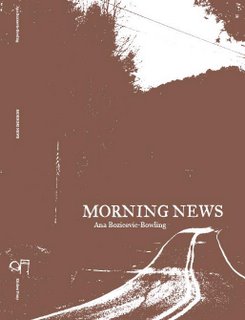 Perhaps the most subtle of the Kitchen Press poets, Croatian-born Ana Bozicevic-Bowling rarely engages in aggressive verbal pyrotechnics in her chapbook Morning News: her virtuosity is generally of a quieter, more minimal kind, sometimes reminiscent of William Carlos Williams’ understated lyrics of the quotidian, as in her brief vignette of her father: “Father / is out in the yard. He shaves / at the bucket [...]” (“Of Water”). To give texture to her language, Bozicevic-Bowling relies not on shock, but on unobtrusive displacements that surprise only after a moment’s reflection, like those paradoxically “warm drifters” of the book’s opening poem (“Prologue”). It is the reader’s growing familiarity with these poems that causes them, like the cafeteria of the same “Prologue,” to “overgrow with meaning.” Those occasional unexpected verbal explosions or troubling minor chords--the “swindled” eye of a child, the “stolen bonbon” of the sun--stand out all the more strikingly for their hushed surroundings (“For Voice and Violin”). The same reserve shows in Bozicevic-Bowling’s readings, which the reader may enjoy on the CD that accompanies Morning News (with music by Denim on Denim). These poems speak the language of deceptive familiarity, the same kind that the poet finds in the “things” she invokes in her final poem, and in the memory of those things:
May these books find readers.
For more information, visit the Kitchen Press website bookstore.
The title of Matt Rasmussen’s collection, Fingergun, speaks volumes. His taut verses are nothing if not action-packed, in the joyful manner of a child’s makebelieve--as long as one keeps in mind the troubling implications of the gun he mimics. In the book’s first poem alone, things unzip, jab, glug, stir, fall off, are pinned or nailed to other things, bolt, spiral down, sprint... (“This Place”). Rasmussen's language is constantly doing something, something virtually violent. Rasmussen repeatedly compares the poems themselves, or perhaps language in its violent performances (blame, accusation...), to the title’s index-finger-firearm: “The warm smoking muzzle of the line” (“The Field at the End of a Poem”). Rasmussen evokes in gory detail the effects of a handgun on his brother in “Dream after Suicide”--only to undo that suicide in the following poem, “Reverse Suicide.” Language, certainly, has no sticks and stones, but can it hurt? Rasmussen offers a compelling and sustained (the emblem of the gun binds the collection into a cohesive whole) reflection on the possibilities of linguistic virtuality (perhaps including real and lasting harm):In the moment between
what happens
and what doesn’t,
the poem huddles.
(“Suddenly, the Poem Is”)
As the mention of “what happens” (and what doesn’t) suggests, Rasmussen constantly explores processes, focused transformations, evolutions--not excluding those of narrative. We witness the miraculous growth of a tube of lipstick into a “garden of mouths” (“Overnight”), the voyage of a bullet through the air (“Bullet”), the recurring motif of the tree’s branching growth (“Suddenly, the Poem Is,” “Overnight”). And like the growth of a tree, the ramifications of Rasmussen’s interlocking metaphors multiply with each new reading.
Even more than Matt Rasmussen, Chris Tonelli favors (very) short forms in his Wide Tree: both writers were Bill Knott’s students at Emerson College, and Tonelli dedicates a brilliant homage to Knott, “Becos.” Tonelli seems to practice something like what Knott calls the “anti-poem”: Tonelli’s scatalogical, off-kilter humor (caveat lector) thumbs its nose at effusive pathos, gnomic gravity and L=A=N=G=U=A=G=E-poet verbiage alike:In the silence
after the fart, he
makes sure that
everyone is okay.
(“The Over-Zealous Philanthropist”)
Such poems do not fear, and do not fail, to entertain. They do not seek density nor complexity, torsions of syntax, idiosyncratic forms of expression: they seek the verbal bang! of laughter, surprise, amusement, perplexity. Tonelli seems unconcerned with making poems that last, rather taking joy in the totally ephemeral, immediate effect of these tiny punchlines. Paradoxically, the childlike vitality of these short poems makes them far more memorable and durable than the great majority of avant garde or post-avant lyrics. And Tonelli occasionally reveals his versatility by surprising the reader once again with lines of striking lyrical force. For instance, he concludes one humorous piece involving a toilet’s automatic-flush function (evoked in a parodically “biblical” style), thus: “Go, // tumble like a manuscript over the lawn” (“At a Theater Urinal”). And Tonelli’s tiny elegy for George Mazzoni is beautiful and moving enough, in my opinion, to be left unquoted here: Find it, and read it.
The title of Justin Marks's own collection, You Being You by Proxy, which is also that of the opening poem, announces the poet’s preoccupation with the problem of divided subjectivity that has occupied so many 20th-century thinkers. This initial poem in fact paradoxically apostrophes a preconscious infant, describing to it the gradual formation of its self--through others: [...] Someday people
will tell you what you were
like as a baby and what they say
will be all you know
about yourself from this time.
Don’t listen.
(“You Being You by Proxy”)
Marks consistently deals with preconscious or semiconscious states, as those ordinarily inaccessible to language. He does not describe them so much as he rhythmically echoes their internal movement. Verses describing the distracted reading of a book emulate the tone of rambling, distracted conversation:
Reading in this manner is more absorbing
than others. I am less critical,
not reading words for what they mean as much
as following them wherever they go.
These poems are meditations; they concern themselves with thinking (and not thinking). Yet they are not self-conscious, solemn and heavy-handed like so many tedious mainstream lyrics, but almost casual, playful, yielding to the movements of noncommittal curiosity. These poems meditate in the manner of the daydream, and manage to capture (rare accomplishment) their common pleasures:
[...] the unformed fragment
of something I was going to say,
[...]
slow enough to notice, though
too quick to follow.
(“Passing thought”)
Yet this very poem, like several others in the book, evokes the specter of suicide just as casually, comparing this “passing thought” to “a body plummet[ing] off / a balcony twelve floors to the marble [...]. A few troubling and discordant notes trouble the surface of these effortless wonderings, perhaps unnoticed by the inattentive reader.
Perhaps the most subtle of the Kitchen Press poets, Croatian-born Ana Bozicevic-Bowling rarely engages in aggressive verbal pyrotechnics in her chapbook Morning News: her virtuosity is generally of a quieter, more minimal kind, sometimes reminiscent of William Carlos Williams’ understated lyrics of the quotidian, as in her brief vignette of her father: “Father / is out in the yard. He shaves / at the bucket [...]” (“Of Water”). To give texture to her language, Bozicevic-Bowling relies not on shock, but on unobtrusive displacements that surprise only after a moment’s reflection, like those paradoxically “warm drifters” of the book’s opening poem (“Prologue”). It is the reader’s growing familiarity with these poems that causes them, like the cafeteria of the same “Prologue,” to “overgrow with meaning.” Those occasional unexpected verbal explosions or troubling minor chords--the “swindled” eye of a child, the “stolen bonbon” of the sun--stand out all the more strikingly for their hushed surroundings (“For Voice and Violin”). The same reserve shows in Bozicevic-Bowling’s readings, which the reader may enjoy on the CD that accompanies Morning News (with music by Denim on Denim). These poems speak the language of deceptive familiarity, the same kind that the poet finds in the “things” she invokes in her final poem, and in the memory of those things: I don’t know what speaks
from things. Their sentences
come not as something
outside of me
but as one of me [...]
(“Thoughts on Things”)
May these books find readers.
For more information, visit the Kitchen Press website bookstore.
Labels: Kitchen Press, reviews
posted by shanna at
7:52 AM
|
0 comments





 Effing Press has just released Is It the King? by Farid Matuk
 Introducing the Onion Union, a new online journal edited by
 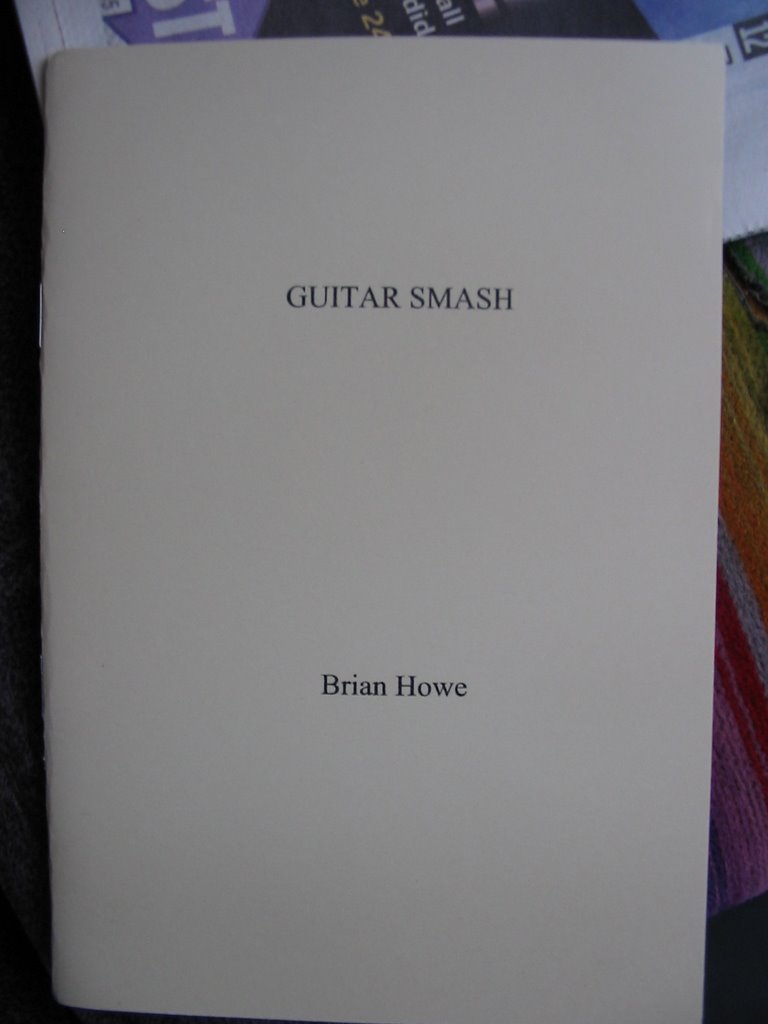 Brian Howe's chapbook Guitar Smash is out too.
 Logan Ryan Smith reviews Parad e R ain by Michael Koshkin
 New! Beat Roots by Anne Waldman, with illustrations by George Schneeman, from Hot Whiskey Press
 And finally, CAConrad's Mooncalf Press offers a new chap by Frank Sherlock
 The first is
  The second book is
  Ron Silliman reviews Erica Carpenter's


